Tuesday, May 23, 2006

Putting my fields in order

I'm back to reading Analysis With an Introduction to Proof, 4th Ed. by Steven R. Lay. This is the book with the proof of the proof by the method of induction that I mentioned the other day. So I've made it through chapter 3, section 11: Ordered Fields relatively quickly largely because this is pretty much all review.

The interesting thing about ordered fields is that all of you are familiar from high school algebra with the things that determine whether something is a field and whether the field is ordered. It's just that nobody bothered to tell you this. An oversight I'm about to correct.

"What," you ask, "are these ordinary things that define fields?" Axioms. The very same axioms you learned in high school. And, yes, I'm going to tell you what they are, but first you need to learn a couple of mathy symbols. ℝ - The set of real numbers, and -the symbol meaning "is a member of" so x ℝ reads "x is a member of the set of real numbers. That's all you need to know.

On to the axioms.

There are 5 axioms for addition.

A1: For all x, y ℝ, x + y ℝ andif x = w and y = z, then x + y = w + z

A2: For all x, y ℝ, x + y = y + x

A3: For all x, y, z ℝ, x + (y + z) = (x + y) + z

A4: There is a unique real number 0 such that x + 0 = x for all x ℝ

A5: For each x ℝ there is a unique real number -x such that x + (-x) = 0.

There are also five axioms for multiplication that will look pretty much like the addition axioms.

M1: For all x, y ℝ, x . y ℝ andif x = w and y = z, then x . y = w . z

M2: For all x, y ℝ, x . y = y . x.

M3: For all x, y, z ℝ, x . (y . z) = (x . y) . z

M4: There is a unique real number 1 such that 1 ≠ 0 and x . 1 = x for all x ℝ.

M5: For each x ℝ with x ≠ 0, there is a unique real number 1/x such that x . 1/x = 1. You can write 1/x as x-1.

Now for the last 5 axioms. You should recognize the first of these since it is the distributive law. This is pretty cool because it shows how addition and multiplication are related to each other.

D1: For all x, y, z ℝ, x . (y + z) = x . y + x . z

Then you have the 4 axioms that define order.

O1: For all x, y ℝ, exactly one of the relations x = y, x > y, or x < y holds (trichotomy law)

O2: For all x, y, z ℝ, if x < y and y < z, then x < z

O3: For all x, y, z ℝ, if x < y, then x + z < y + z

O4: For all x, y, z ℝ, if x < y and z > 0, then x . z < y . z

Actually, any set of numbers or mathematical system where the first 11 axioms are true is a field. If all 15 axioms are true, you have an ordered field. The set of rational numbers makes up an ordered field, but the set of integers does not (do you see why?).

Reference: Lay, S.R. (2005). Analysis With an Introduction to Proof, 4th Ed. Pearson-Prentice Hall: Upper Saddle River, NJ. pp 108 - 112.

Saturday, May 20, 2006

Just a test of sorts

I've been thinking that I'd like to have an editor where I could create and edit entries off-line (because I have dial-up) and then publish later. But I want to see what they'll look like for real. It's a pain to copy, past, and correct a Word doc. So this is a test of one editor. I'll take suggestions on any others out there that you all know about, but I have to tell you that until I'm working again I can only do free.

Technorati Tags :
Powered By Qumana

Friday, May 19, 2006

Friday miscellany

Today was my last day at the company I've temped at for a year. I made some new friends working there - I'll miss seeing them every day. The temp agency said that they would be in touch the beginning of next week about a new job, but I'm thinking I should hit the streets on Monday and spread my resume around. I really have to get myself revved up for that one.

I like to check stat counter to see where people have come from on their way to my blog. When I did that tonight, I found my way to an interesting blog -
A Sweet, Familiar Dissonance. And I got as close to a rave review as I'm ever going to get. *grin*

Two links for tonight.

The first is about the "discovery" of a possibly habitable planetary system at
MSNBC. It's really cool how planets are found - lots of math.

The second (which is really three) is at
Science and Politics - Teaching the bare bones of Biology and Teaching Update. I wish I'd had this guy for a biology teacher. He also has a really interesting post about Lyme Disease here.

If any of you think that I've run out of things to say about order and mathematics, think again. There will be more order coming to you. *hehehe*


Wednesday, May 17, 2006

Nothing special

Two more days and the job from hell is finished. Unless something pops, I'll be unemployed. So what did I do about this today? I read a proof of the method of proof by induction. Do you think that mathematicians may be a tad anal if they feel the need to prove that a method of proof is valid?

Tuesday, May 16, 2006

What do you really think of NUMB3RS?

Or more to the point, what do mathematicians think of NUMB3RS? For a partial answer, see the discussion on Ars Mathematica.

Sunday, May 14, 2006

Rain and more rain and more...

It's raining.

Blog mom talks about the rain by her here and Yahoo has the AP story here. We're lucky this time around with only a flood watch, but no warning for the county I live in. The New Hampshire TV station spent an hour tonight on flood news. It was nice to hear towns with evacuations telling residents to bring their pets because arrangements had been made for them. Frustrating to hear that people were out "sight seeing" when the they're being told to stay home because of the danger with roads washed out.

I know it's selfish, but I'm glad that the probability of repeating last fall's washout is relatively slim.

Friday, May 12, 2006

Friday miscellany

Last week I got shifted from the temp job I've had since May '05 to a different temp job at the same company. I HATE it! I'm spending 6 - 8 hours a day on the telephone. This is hell for me - after all, I'm the person who when she needed to cut expenses got rid of her phone for over a year and DID NOT miss it. If it wasn't for the fact that I have to support myself.... *sigh*

That said, some linky stuff to annoy, amuse, or inform you.

From
Mixing Memory: an interesting post on a study of about how Craving a Cigarette Warps Your Sense of Time. Having sat through all the speeches at a college graduation (which by themselves warp time), I can confidently say that craving a cigarette when you have to pee and can't do either really warps time. I swear it took at least 5 or 10 minutes for the speaker to utter a one syllable word. You can imagine how long the bigger words took. *grin*

From
Science and Politics: a link to a letter to the editor about faith vs. ethics. Love this part of the letter - "The irrational mind knows no boundaries and has no tolerance for self-restraint. It is the rational mind that can set boundaries and control impulses."

And a new blog to check out -
Heo Cwaeth. You'll have to read it to find out what the blog is all about. I found it via Mixing Memory.

I could rant for months on this story on Yahoo -
No States Meet Teacher Quality Goal.

And check out blog daughter Zephyr's post about being a student at a beauty academy.


and

Thursday, May 11, 2006

More order

Since math and order have arisen here and here, it's time that I introduced you to the Well-Ordering Property. This is one of those incredibly simple statements, but its important particularly when you are talking about sets.

The Well-Ordering Property: Every non-empty set of positive integers has a least element.

That's it. Notice that it says nothing about the numbers being in order (ie., 1, 2, 3, 4). Only that a set with at least one element (non-empty) will have a least or smallest element.

Before you ask, this property addresses only positive integers because the set of negative integers has no least element. Rememeber that the negative integers go -1, -2, -3, and that -1 is greater than -2 which is greater than -3 and so forth. So while the set of positive integers is well-ordered, the set of negative integers is not.

Tuesday, May 09, 2006

I am so good (LOL)

Grades were posted today.
Psych of Learning - A
History & Systems - A
Honors Research - pass (pass/fail only)
Honors Research Seminar - pass (pass/fail only)

GPA is now at 5.67 3.547.

(I was trying so hard to be "smarter" than I am, but I have no idea where the 5.67 came from. This time I copied/pasted so it's the correct number. *grin*)

I am just so good. ROFLMAO

Odd and even numbers - answers for VW

VW asked some questions about odd and even numbers in her comment to this post and since I live to torture you all, here are the questions and the answers. *grin*

1. Why does adding two even numbers give an even number?
2. Why does adding two odd numbers give an even number?
3. Why does adding an odd and an even number give an odd number?
4. Why aren’t there more even than odd numbers?

I’ll answer each one for you although the last is going to take the most explaining. *grin* So, here goes.

To start with, the answers to these questions are referring only to integers (…, -3, -2, -1, 0, 1, 2, 3, …).

There are several things to keep in mind.
When you add two integers, the answer is always another integer (this is a property of the set of integers called closure).
The associative property – for any integers m, n, p; m + n + p = (m + n) + p = m + (n + p).
The distributive property – for any integers a, b, c; ab + ac = a(b + c).

Now onto the first three questions.

1. Why does adding two even numbers give an even number?

Let’s start with a definition. We are defining an even number as a number that when divided by 2 has no remainder. We can write any even number as 2k where k is any integer. It doesn’t matter if it’s even or odd since multiplying by 2 immediately makes the result (2k) even.

Now add two even numbers. By the definition above, we can choose any two even numbers. Let’s call them 2k and 2m where k and m are integers.

Do the arithmetic: 2k + 2m = 2(k +m) by the distributive property. (k + m) is an integer because adding two integers always results in another integer. Since 2(k + m) is divisible by 2 with no remainder (see our original definition), adding 2k + 2m results in an even number.

2. Why does adding two odd numbers give an even number?

First we’ll define an odd number as a number that when divided by 2 results in a remainder of 1. We know that for any n = 2k, n is even from above. What we want is an n that is odd. By our definition of an odd number, n = 2k + 1 is odd because when we divide n by 2 we end up with a remainder of 1.

Now add two odd numbers. As above, we can choose any two odd numbers. Let’s choose n = 2k + 1 and m = 2r + 1 where k and r are integers.

Next the arithmetic: n + m = (2k + 1) + (2r + 1) = 2k + 2r + 2 (combining like terms).
2k + 2r + 2 = 2(k + r + 1) by the distributive property. Since k, r, and 1 are integers, (k + r + 1) is also an integer. So we now have an even number by our previous definition of an even number.

3. Why does adding an odd and an even number give an odd number?

Choose any odd number m = 2k + 1 (by our previous definition of an odd number) and any even number n = 2p (by our previous definition of an even number) where m, k, n, and p are integers. Now do the addition.

m + n = (2k + 1) + (2p) = 2k + 2p + 1 = (2k + 2p) + 1 (by the associative property) and
(2k + 2p) + 1 = 2(k + p) + 1 (by the distributive property). Since k and p are integers, k + p is an integer, and so we have by definition an odd number.

Now for the last question – why aren’t there more even than odd numbers?

I need to start by talking about infinite sets and how we tell their “size” or cardinality in math speak. The set of natural numbers (counting numbers – 1, 2, 3, …) is an infinite set. It’s a countably infinite set because (at least in theory) you could count all the members of the set. Of course, since there is no “largest” natural number, you’d never actually count to the end. Georg Cantor, when he described infinite sets, said that the set of natural numbers has a cardinality (size) of aleph-0. All countably infinite sets have this cardinality of aleph-0. So all countably infinite sets are the same size. Got that?

In order to show that a set is countably infinite, I have to find a way to match each member of the set to each member of the set of natural numbers. This is a one-to-one correspondence between the two sets. The good thing is that I can rearrange the numbers in the set I’m trying to put into one-to-one correspondence with the set of natural numbers – order, in the every day sense, doesn’t matter in this case.

Let’s start with the even numbers. The set of even numbers (I’m using integers) is (…, -6, -4, -2, 0, 2, 4, 6, …). This is a problem because the even numbers go on forever in the negative and in the positive direction. But I can reorder the set and end up with (0, -2, 2, -4, 4, -6, 6,...).

With this reordering, I can make the match to the set of natural numbers like this (my one-to-one correspondence) by lining up the natural numbers under the even numbers.

0 -2 2 -4 4 -6 6 and so forth (the even numbers)
1 2 3 4 5 6 7 and so forth (the natural numbers)

Since there is a one-to-one correspondence between the set of even numbers and the set of natural numbers, the set of even numbers is countably infinite and has the same cardinality (size) as the natural numbers – aleph-0.

The odd numbers work the same way.

Reorder the set of odd numbers (…, -5, -3, -1, 0, 1, 3, 5, …) to (0, -1, 1, -3, 3, -5, 5, …).
Now you can make a one-to-one correspondence to the natural numbers in the same way as for the even numbers. With this one-to-one correspondence, the set of odd numbers is countably infinite and so has a cardinality (size) of aleph-0.

Since the set of odd numbers and the set of even numbers both have a cardinality of aleph-0, they are the same size.

Tada!

BTW – the set of rational numbers (your fractions – ½, ¼) is also countably infinite which makes it the same size as the set of integers, the set of even numbers, and the set of odd numbers. The set of real numbers (includes the integers, the rationals, and the irrational numbers) though, is uncountably infinite and has a different cardinality. Proofs are here. I think the proof for the rational numbers is pretty slick.


Sunday, May 07, 2006

College graduation

Today I watched two college friends graduate. I'm feeling a little bit like the mother hen who has just ushered the chicks out of the nest. And I'm so proud of these two young women. Let me tell you a little about them. We'll call them Chick1 and Chick2 (the numbers are the order I met them in).

When I returned to college to complete my math degree, I had tons of math, science, and programming courses, but virtually none of the dreaded general education courses. As a result I took way more gen ed courses than math courses and met a lot of freshmen students who weren't math majors. Most of them were and are totally not memorable, but two became something very like little sisters to me.

My first semester I met Chick1. We were assigned to the same team for a major presentation. Chick1 was terrified of public speaking to the point that she'd pass out. Not good when a large chunk of your grade is dependent on one presentation. So the erstwhile housemate and I practiced with Chick1 until she knew her part of the presentation so well that nothing could shake her. And I kept on giving pep-talks, lots and lots of pep-talks. We aced the presentation and somehow Chick1 became the person I most wanted to see succeed in college. She's funny, smart, energetic, caring, and so much more. She was also having a tough time with her school work. The story of how she dealt with that is hers, but by the end of her second year she was on the dean's list every semester and graduated with membership in two honors societies. At today's graduation, Chick1 told me that she'd gotten accepted to grad school for her masters. I am so proud of her.

I met Chick2 my second semester. We might never have gone past the surface conversations between two people who are in the same class except that I needed to interview someone whose work was unusual in some way for a cultural anthropology class. I have to side track a bit here and tell you that I run screaming from anyone who tries to preach to me or shove their religion down my throat. As a result, I tend to avoid people who appear to be openly religious. (And I am NOT discussing this with anyone here.) In one of our earlier conversations, Chick2 had told me that she wanted to be a missionary. There were a few more conversations about this where I learned that she spent her school breaks doing missionary work. Okay, this pretty well covers unusual work in my book. Chick2 was nice enough to agree to be the subject of the paper. That interview lead to a friendship which I value deeply. Chick2 is one of the most giving people I know. She is also one of the few people I know who lives her religion rather than preaches it. The world needs more good people. I think Chick2 is one of these good people (even if she doesn't entirely approve of my often raunchy humor).

So the chicks left the nest today. Next year as I finish up the last couple of classes for my psych degree will feel very strange without these two young women on campus.

Saturday, May 06, 2006

Does order matter?

It’s time to return to those mathy things that I know you all hold your breath in anticipation of. In the comments to this post, Teresa asked if the order mattered since multiplication is commutative. The idea that multiplication is commutative follows fairly naturally when you think of multiplication as a sister to addition. Multiplying 3 by 2 is the same as adding 3 two times - 2 x 3 = 3 + 3 = 6. By the same process, 3 x 2 = 2 + 2 + 2 = 6. So she’s right that in the case of the set of integers (and I've used integers in these examples), multiplication is commutative and order doesn't matter. But multiplication is not always commutative.

A matrix, as opposed to the matrix of movie fame, is an array of numbers. You will often see a matrix referred to as an (m x n) matrix where m and n denote the number of rows and columns, respectively. Matrix multiplication is not commutative.


Here's your math lesson for the day.


In order to multiply 2 matrices, the number of columns in the first matrix must equal the number of rows in the second matrix. If you have an (m x n) matrix multiplying an (r x s) matrix, you must have n = r. The funny thing is that if you switch the order so that you're multiplying the same (r x s) matrix by the same (m x n) matrix, then you need s = m.

Here's an example: if matrix A is a (3 x 3) matrix and matrix B is a (3 x 1) matrix, you can multiply A by B – a (3 x 3) multiplying a (3 x 1), where n and r both equal 3. But you can’t commute the two matrices. Multiplying B by A is undefined since you have a (3 x 1) multiplying a (3 x 3) and n = 1 while r = 3.

But what if you have two matrices with the same number of rows and columns? Shouldn't they be commutative? First, you need to know how matrix multiplication is performed. The simple (text book) definition looks like this:


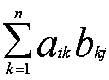
For a matrix A = (aij) and a matrix B = (bij), the product AB is defined as

In math speak that makes very little sense. It looks something like this.

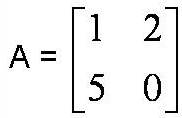
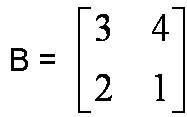
Nasty! Let’s try an example with numbers. I’m going to use (2 x 2) matrices A and B where


and


When you multiply AB, you get

And when you multiply BA, you get


So, for this example, you can see that AB is not equal to BA. There are occasional instances where AB will equal BA, but this is not generally true.

Just to briefly return to the Fundamental Theorem of Arithmetic where this started. The theorem orders the prime factors. This is important within the proof - order matters - but I think we’ll get to that tomorrow.

Reference: Johnson, L.W., Riess, R.D. & Arnold, J.T. (2002). Introduction to Linear Algebra (5th ed.). Boston, MA: Addison-Wesley.


Thursday, May 04, 2006

The semester is over

If you watch Iron Chef America, in my mind I'm hearing "the semester is over" in the same voice.

I'll know next week what my grades are. The honors project is pass/fail and that has already been posted - pass. 4 credits. Nothing that counts towards my GPA. What's really sad is that I'll be working on the blasted thing this summer without earning credit, but what the heck I don't have to pay for credits either.

Tomorrow I'll get back to all the fun stuff (like math) that got dropped while in the end of semester crunch. BTW - that fit learning theory into 4 page paper was an A. hehehe.

Monday, May 01, 2006

Revision 6? 7?

I've lost count. Major revisions get a new number, small changes might get a letter designation. Confused? They're just changes in the file name. I start with paper, go to paper1, paper2, and so forth when the revisions are major. A small change to paper2, but one where I want to keep the original paper becomes paper2a. Got it? I'm on paper6 which was a major revision of paper5a. Swear to god if I ever get this thing finished, I'm posting the whole paper on this blog. You all might want to run away while you still can.

Like the terminator, I will be back. LOL

Thursday, April 27, 2006

I'm exhausted, about to be unemployed, and...

relatively happy. I had a meeting with my advisor for my honors research project today. He's happy with the paper, but asked if I would add some more stuff. Fortunately, I have most of the "more stuff" in another paper and, yes, I can take that stuff and reuse it. *stuff, stuff, stuff, la dee da dee da, stuff, stuff stuff*

My favorite comment from Gary - "maybe go the ontogeny/phylogeny route --> become rich, famous!" (yeah, right)

Now I have to put together all of the various and sundry things needed for submission to the IRB (Institutional Review Board - the people who tell me whether or not I can actually run the study). And add the *stuff* and review for finals next week and find another job.

Well, sh*t.

Tuesday, April 25, 2006

What are they looking for?

Recent searches that landed here.

sister incest
dog die graph pie
biased math bar graph

Some people have too much time on their hands.

Sunday, April 23, 2006

Sunday Science

I'm finishing up a paper for the History & Systems class - compare and contrast the learning theories of Thorndike, Kohler, and Tolman in 4 pages. It's the 4 page limit that causes the problems. So I needed a break and found this on Yahoo News.


Interesting enough to warrant a trip to the library to read the paper.

,

Saturday, April 22, 2006

The other twin has arrived!

My gorgeous, charming, funny niece who is now my other blog daughter has arrived. Check out her description of herself - this is so the niece. You can find her at Zephyr's Place.

And remember all you dirty old men out there that I may be gun deficient, but I'm handy with a knife. *hehehe*

Friday, April 21, 2006

Friday Miscellany

Yesterday when I went outside on a break some of the guys were tossing around a softball. In the random way that thoughts go, this reminded me of playing baseball with the neighborhood kids. I'm a total loss at sports, but that didn't matter. Usually the two oldest boys made up one team and all the rest of us were the other team. When it was my turn at bat the oldest boy in the neighborhood (he was 4 or 5 years older than me) would stand behind me and help me hold the bat and swing. Okay he swung and I just followed along for the ride. I was about 10 and had such a crush on this boy.

The random thoughts rambled on. We played outside a lot. This was in the days before computers and video games and a gazillion TV channels. Every Sunday we watched The Wonderful World of Disney (or whatever it was called then). Which leads to my first TV character/actor crush. In 1964 Disney ran a show that was 3 episodes (I know cause I
looked it up) called The Scarecrow of Romney Marsh. I was soooooo in love with the Scarecrow and with Patrick McGoohan who it turns out was born in Astoria, Long Island, New York 16 years after my father was born there. Go figure.

Because it's been on my mind this week, a little bit of history from 1971. This was the year I turned 18 and registered to vote. My mother took me down to the town hall to register. Now, this was a Republican town and my parents were registered Republicans. I wanted to register Independent, but the town clerk got all fussy about primaries and stuff. So, in an act of rebellion, I said that I'd register Democratic. The town clerk actually asked my mother if that was all right with her.

26th. Amendment to the U.S. Constitution

Section 1. The right of citizens of the United States, who are eighteen years of age or older, to vote shall not be denied or abridged by the United States or by any State on account of age.

Section 2. Congress shall have power to enforce this article by appropriate legislation.

Proposal and Ratification

This amendment was proposed by the Ninety-second Congress by Senate Joint Resolution No. 7, which was approved by the Senate on Mar. 10, 1971, and by the House of Representatives on Mar. 23, 1971. It was declared by the Administrator of General Services on July 5, 1971, to have been ratified by the legislatures of 39 of the 50 States.

This amendment was ratified by the following States: Connecticut, March 23, 1971; Delaware, March 23, 1971; Minnesota, March 23, 1971; Tennessee, March 23, 1971; Washington, March 23, 1971; Hawaii, March 24, 1971; Massachusetts, March 24, 1971; Montana, March 29, 1971; Arkansas, March 30, 1971; Idaho, March 30, 1971; Iowa, March 30, 1971; Nebraska, April 2, 1971; New Jersey, April 3, 1971; Kansas, April 7, 1971; Michigan, April 7, 1971; Alaska, April 8, 1971; Maryland, April 8, 1971; Indiana, April 8, 1971; Maine, April 9, 1971; Vermont, April 16, 1971; Louisiana, April 17, 1971; California, April 19, 1971; Colorado, April 27, 1971; Pennsylvania, April 27, 1971; Texas, April 27, 1971; South Carolina, April 28, 1971; West Virginia, April 28, 1971; New Hampshire, May 13, 1971; Arizona, May 14, 1971; Rhode Island, May 27, 1971; New York, June 2, 1971; Oregon, June 4, 1971; Missouri, June 14, 1971; Wisconsin, June 22, 1971; Illinois, June 29, 1971; Alabama, June 30, 1971; Ohio, June 30, 1971; North Carolina, July 1, 1971; Oklahoma, July 1, 1971.

Ratification was completed on July 1, 1971.

The amendment was subsequently ratified by Virginia, July 8, 1971; Wyoming, July 8, 1971; Georgia, October 4, 1971.

Certification of Validity Publication of the certifying statement of the Administrator of General Services that the amendment had become valid was made on July 7, 1971, F.R. Doc. 71 099691, 36 F.R. 12725.

Created by Martin Luther King, Jr., National Historic Site Interpretive Staff

Last week's poem generated some comments not at all related to the poem (or anything else for that matter). So this week I'm going to try some song lyrics that ought to really get out the crazy comments. This song is actually what got me to go and look for the dates of ratification on the 26th Amendment.


Eve of Destruction
by P.F. Sloan
Recorded by Barry McGuire (1965)

The eastern world, it is explodin’.
Violence flarin’, bullets loadin’
You’re old enough to kill, but not for votin’
You don’t believe in war, but what’s that gun you’re totin’
And even the Jordan River has bodies floatin’

But you tell me
Over and over and over again, my friend
Ah, you don’t believe
We’re on the eve
of destruction.

Don’t you understand what I’m tryin’ to say
Can’t you feel the fears I’m feelin’ today?
If the button is pushed, there’s no runnin’ away
There’ll be no one to save, with the world in a grave
[Take a look around ya boy, it's bound to scare ya boy]

And you tell me
Over and over and over again, my friend
Ah, you don’t believe
We’re on the eve
of destruction.

Yeah, my blood’s so mad feels like coagulatin’
I’m sitting here just contemplatin’
I can’t twist the truth, it knows no regulation.
Handful of senators don’t pass legislation
And marches alone can’t bring integration
When human respect is disintegratin’
This whole crazy world is just too frustratin’

And you tell me
Over and over and over again, my friend
Ah, you don’t believe
We’re on the eve
of destruction.

Think of all the hate there is in Red China
Then take a look around to Selma, Alabama
You may leave here for 4 days in space
But when you return, it’s the same old place
The poundin’ of the drums, the pride and disgrace
You can bury your dead, but don’t leave a trace
Hate your next-door neighbor, but don’t forget to say grace
And… tell me over and over and over and over again, my friend
You don’t believe
We’re on the eve
Of destruction
Mm, no no, you don’t believe
We’re on the eve
of destruction.

Thursday, April 20, 2006

One out, another on the way


One down (or out as the case may be) and one to go. The first of my twin blog daughters is MY SISTER! (More bloggy incest) After months of sending her links to interesting blog stuff and having her send me the comments, Easter Sunday I got her to register on the blogspot place. Then....well you can go here and check it out. Our little test posts are still there - an extra virtual chocolate cigar to anyone who gets them. *grin*

I could tell you lots about the other sister person, but I'll be good. I'm hoping that she'll post pictures of some of her needlework. I just saw her newest piece - an original design for one of those pretty purses brides carry (a friend's daughter is getting married). What you won't know from any pictures she might post is that the reverse side of her needlework is just about as perfect as the front. She also quilts - one year she was one of the Hoffman Challenge winners. She sings. She cooks (one of us has too). She loves colors like orange. The other stuff you'll have to learn from her.

So with no further ado, my first baby girl - The Other Sister Person