Friday, April 14, 2006

Friday miscellany

After doing my best to screw up my fall registration, it's straightened out. I think. There was a message for me when I got home tonight from the registrar so I won't know for sure until Monday. *sigh* In the meantime I'm still working on the paper for my honors research and working on more of the Fundamental theorem of Arithmetic. (Now don't you all run away screaming. Save that for when I finally find the picture of me in my hippie dippie days. *grin*)

I'm continuing on the Friday poetry kick. This poem contains one of my favorite lines -

"I grow old... I grow old...
I shall wear the bottoms of my trousers rolled. "


So I present to you The Love Song of J. Alfred Prufrock by T.S. Eliot.

S'io credesse che mia risposta fosse
A persona che mai tornasse al mondo,
Questa fiamma staria senza piu scosse.
Ma perciocche giammai di questo fondo
Non torno vivo alcun, s'i'odo il vero,
Senza tema d'infamia ti rispondo.

Let us go then, you and I,
When the evening is spread out against the sky
Like a patient etherised upon a table;
Let us go, through certain half-deserted streets,
The muttering retreats
Of restless nights in one-night cheap hotels
And sawdust restaurants with oyster-shells:
Streets that follow like a tedious argument
Of insidious intent
To lead you to an overwhelming question...
Oh, do not ask, "What is it?"
Let us go and make our visit.

In the room the women come and go
Talking of Michelangelo.

The yellow fog that rubs its back upon the window-panes,
The yellow smoke that rubs its muzzle on the window-panes
Licked its tongue into the corners of the evening,
Lingered upon the pools that stand in drains,
Let fall upon its back the soot that falls from chimneys,
Slipped by the terrace, made a sudden leap,
And seeing that it was a soft October night,
Curled once about the house, and fell asleep.

And indeed there will be time
For the yellow smoke that slides along the street,
Rubbing its back upon the window-panes;
There will be time, there will be time
To prepare a face to meet the faces that you meet;
There will be time to murder and create,
And time for all the works and days of hands
That lift and drop a question on your plate;
Time for you and time for me,
And time yet for a hundred indecisions,
And for a hundred visions and revisions,
Before the taking of a toast and tea.

In the room the women come and go
Talking of Michelangelo.

And indeed there will be time
To wonder, "Do I dare?" and, "Do I dare?"
Time to turn back and descend the stair,
With a bald spot in the middle of my hair
[They will say: "How his hair is growing thin!"]
My morning coat, my collar mounting firmly to the chin,
My necktie rich and modest, but asserted by a simple pin
[They will say: "But how his arms and legs are thin!"]
Do I dare
Disturb the universe?
In a minute there is time
For decisions and revisions which a minute will reverse.

For I have known them all already, known them all:
Have known the evenings, mornings, afternoons,
I have measured out my life with coffee spoons;
I know the voices dying with a dying fall
Beneath the music from a farther room.
So how should I presume?

And I have known the eyes already, known them all
The eyes that fix you in a formulated phrase,
And when I am formulated, sprawling on a pin,
When I am pinned and wriggling on the wall,
Then how should I begin
To spit out all the butt-ends of my days and ways?
And how should I presume?

And I have known the arms already, known them all
Arms that are braceleted and white and bare
[But in the lamplight, downed with light brown hair!]
It is perfume from a dress
That makes me so digress?
Arms that lie along a table, or wrap about a shawl.
And should I then presume?
And how should I begin?

Shall I say, I have gone at dusk through narrow streets
And watched the smoke that rises from the pipes
Of lonely men in shirt-sleeves, leaning out of windows?...

I should have been a pair of ragged claws
Scuttling across the floors of silent seas.

And the afternoon, the evening, sleeps so peacefully!
Smoothed by long fingers,
Asleep... tired... or it malingers,
Stretched on the floor, here beside you and me.
Should I, after tea and cakes and ices,
Have the strength to force the moment to its crisis?
But though I have wept and fasted, wept and prayed,
Though I have seen my head (grown slightly bald) brought in upon a platter,
I am no prophet and here's no great matter;
I have seen the moment of my greatness flicker,
And I have seen the eternal Footman hold my coat, and snicker,
And in short, I was afraid.

And would it have been worth it, after all,
After the cups, the marmalade, the tea,
Among the porcelain, among some talk of you and me,
Would it have been worth while,
To have bitten off the matter with a smile,
To have squeezed the universe into a ball
To roll it toward some overwhelming question,
To say: "I am Lazarus, come from the dead,
Come back to tell you all, I shall tell you all"
If one, settling a pillow by her head,
Should say: "That is not what I meant at all.
That is not it, at all."

And would it have been worth it, after all,
Would it have been worth while,
After the sunsets and the dooryards and the sprinkled streets,
After the novels, after the teacups, after the skirts that trail along the floor
And this, and so much more?
It is impossible to say just what I mean!
But as if a magic lantern threw the nerves in patterns on a screen:
Would it have been worth while
If one, settling a pillow or throwing off a shawl,
And turning toward the window, should say:
"That is not it at all,
That is not what I meant, at all."

No! I am not Prince Hamlet, nor was meant to be;
Am an attendant lord, one that will do
To swell a progress, start a scene or two,
Advise the prince; no doubt, an easy tool,
Deferential, glad to be of use,
Politic, cautious, and meticulous;
Full of high sentence, but a bit obtuse;
At times, indeed, almost ridiculous
Almost, at times, the Fool.

I grow old... I grow old...
I shall wear the bottoms of my trousers rolled.

Shall I part my hair behind? Do I dare to eat a peach?
I shall wear white flannel trousers, and walk upon the beach.
I have heard the mermaids singing, each to each.

I do not think that they will sing to me.

I have seen them riding seaward on the waves
Combing the white hair of the waves blown back
When the wind blows the water white and black.

We have lingered in the chambers of the sea
By sea-girls wreathed with seaweed red and brown
Till human voices wake us, and we drown.

,

Thursday, April 13, 2006

Is mass media biased?

I know that a lot of people feel that the mass media is biased. There is an interesting entry addressing this belief over at Mixing Memory - Hostile Media Effects. Take a look and make sure you read the comments.

,

Wednesday, April 12, 2006

Ask and ye shall receive

In response to this post Harvey asked, "what's the Fundamental Theorem of Arithmetic?" To some extent I think that the name is a bit of a misnomer, but for now I'll give you the theorem without proof. The proof is relatively simple and is interesting in as much as it illustrates the process of mathematical thinking. But before I entertain you with that, I need to sit down and do a little bit of work to provide comprehensibility for the non-math people.

The Fundamental Theorem of Arithmetic Every positive integer greater than 1 can be written uniquely as a product of primes, with the prime factors in the product written in nondecreasing order.

For example, the prime factorization of the positive integer 1001 = 7 * 11 * 13.


Monday, April 10, 2006

Left turn to nowhere

I noticed today that Site Meter is registering 1,012 visitors. Only took seven months to get there. *grin* Some of those 1,012 visitors took a left turn on their way here. Like the person who did a search on "vector space and subspace solved examples." Not at all sure why I reaped the benefit of that search, but at least I know what a vector space is. Do you?

Saturday I picked up a new book on number theory - my feel better purchase because I hadn't been able to meet Teresa for the book signing. I'll have to get my act together and share any gems from that including the Fundamental Theorem of Arithmetic. I know you all are holding your collective breaths in anticipation of that.

,

Wednesday, April 05, 2006

Huh? Part deux

The graphs that the grad student will be talking about are not the graphs most of you envision. Unless you happen to be "into" math, a graph is usually the line (or points) you plot using x-y coordinates. Excel produces all sorts of graphs from data you enter - bar graphs, line graphs, pie charts, etc. When you think of graphs in this everyday sense, the abstract makes even less sense. It really is a "huh?" moment.

For the record, graph theory is defined at Mathworld as "the mathematical study of the properties of the formal mathematical structures called graphs." Not particularly enlightening. However, go here and read about graphs. This write-up is accessible to all of you although you might want to skip the links to eigenvalues. These graphs are actually pretty neat. I did go to a seminar a couple of years ago that was an introduction to graph theory. We all got to try and work out the bridge problem (you'll have to go to the link to find out what that is).

Tuesday, April 04, 2006

Huh?

I was going to use some comp time I have to go to the Friday math presentation until I read the abstract.
Abstract: Spectral Graph Theory is a relatively new field of mathematics which seeks to use ideas from continuous geometry to learn more about graphs. In this talk, I will introduce graphs and the adjacency operator on graphs. I will briefly outline some of the applications of graphs and some classical problems to give an idea of this rich field. Then we will turn to the spectrum of the adjacency operator. Surprisingly, these eigenvalues have great impact on very tangible properties of the graph. I will show how they provide a bound on the diameter.
The person speaking is a grad student at Dartmouth. I can guarantee that I'll never be smart enough for this. *grin*

Saturday, April 01, 2006

My old cat

Update: My old kitty has gone off to where ever it is crotchety cats go. He had a fairly large tumor in his kidney that had metastasized. There wasn't anything to be done for him but hold him and let him go. I'll miss the boy.


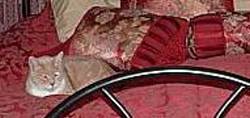
This is my old cat relaxing on his bed about a year ago. Today I took him to the vet. He'd gotten that old cat bony look this past year, but this week things got really out of hand and he's been refusing food. He's at the vets now getting fluids and nourishment via an IV. They're also doing a full set of blood tests. And he had an x-ray - there is some sort of mass showing up in his stomach. Depending on how he does over the next couple of days (and the results of the blood work), he may have an ultrasound on Wednesday to try to determine what the mass is and if it's fixable. The vet flat out said that it probably wouldn't be. Surgery is a crap shoot with him anyway. The last time he had his teeth cleaned he almost didn't make it out of the anesthesia.

I'm feeling as if my final ties to my old home are being severed. When my husband and I moved here, we brought our 3 dogs and the cat. My husband and all 3 dogs have died. Now I will probably loose my bad tempered cat.

I know that in the bigger picture this is a non-starter, but....

Friday, March 31, 2006

Friday Miscellany

It's been a weird week - very busy at work, a meeting with my honors' advisor which actually went very well, and a mini-spending spree. I took out the plastic and went on Amazon. Today my purchases arrived - more music. I now have Belafonte at Carnegie Hall (1959) which has what I think is the best ever recording of Danny Boy. And just to further confirm that I'm an aging hippie, the rest of the music purchase was the 4 CD set of the Woodstock 25th anniversary collection. (Peace and love, baby)

I was going to tell you all a little about the fundamental theorem of arithmetic, but I've decided to save it for later this weekend when the psychology stuff begins to drive me around the bend. Instead I have for you more of my favorite poetry.

In my junior and senior years of high school, I had an English teacher who (probably inadvertently) taught me to learn about the things I love and do it with passion. He loved poetry. He'd act out a poem as he recited and get incredibly excited. One day he got a little carried away. He had one of those old wooden office chairs that twirled around and was on wheels. In a fit of excitement, he threw himself into the chair, pushed off from the desk, and flew across the room, through the open door, and slammed across the hall almost taking out the principal. In the spring, he read e.e. cummings' poem "in Just-" and jumped in imaginary mud puddles.

So, to celebrate the arrival of spring (finally), here is the poem I most associate with spring.

in Just-

in Just-spring
when the world is mud-
luscious the
little lame baloonman


whistles far and wee


and
eddyandbill come
running from marbles and
piracies and it's
spring


when the world is puddle-wonderful


the queer
old
baloonman whistles
far and wee
and bettyandisbel come dancing


from hop-scotch and jump-rope and


it's
spring
and
the
goat-footed


baloonMan whistles
far
and
wee

e.e. cummings


taggy taggy: ,

Saturday, March 25, 2006

Friday Miscellany on Saturday

Because I was tired last night and really couldn't think of anything to say. And Carmen tagged me, but I'll get to that in the next day or two.

Lately I've been thinking about number theory, Hilbert's program, and arithmetic. And I've been wondering if the axioms of arithmetic constitute a mathematical description of the cognitive processes underlying arithmetic. Hilbert's program was simply (although it wasn't simple) an effort to formalize mathematics in axiomatic form and to show the consistency of the system. Godel threw a bomb into the effort with his Incompleteness theorem.

A more thorough and better description of Hilbert's program is available at The Stanford Encyclopedia of Philosophy - Hilbert's Program.

Today's tags: ,

Saturday, March 18, 2006

It's real (sort of)

I filed my intent to graduate last week. In an amazingly fast turn around, the college has already completed the academic audit and sent it to me. No surprise in the audit. I have one more course to take (the honors research is a separate entity). The down side? The last course - Sensation and Perception - isn't available until the Spring 2007 semester. *sobbing*

taggy taggy:

Friday, March 17, 2006

Friday Miscellany

This week's miscellany ... hmm ... a little bit of science and a little bit of poetry.

First the science (see I don't always torture my gentle readers with math).

Take a look at this explanation of why we have so much trouble with the concept of evolution as presented at Mixing Memory: Thinking About Evolution: Cognitive Factors That Get in the Way. I'd call this a definite "must read."

Then there is poetry. I grew up in the Northeast at the end of the 60s. It seemed that we were all either writing poetry, writing songs, or writing both. When the theme wasn't the evils of war, the poetry was pretty self-consciously arty. You can, however, breath a sigh of relief. The poetry is not mine, but William Blake's. This is just one of my favorite poems and has been rattling around in my head all week.

The Tyger
William Blake

Tyger Tyger. burning bright,
In the forests of the night;
What immortal hand or eye.
Could frame thy fearful symmetry?

In what distant deeps or skies.
Burnt the fire of thine eyes?
On what wings dare he aspire?
What the hand, dare seize the fire?

And what shoulder, & what art,
Could twist the sinews of thy heart?
And when thy heart began to beat.
What dread hand? & what dread feet?

What the hammer? what the chain,
In what furnace was thy brain?
What the anvil? what dread grasp.
Dare its deadly terrors clasp?

When the stars threw down their spears
And watered heaven with their tears:
Did he smile His work to see?
Did he who made the lamb make thee?

Tyger Tyger burning bright,
In the forests of the night:
What immortal hand or eye,
Dare frame thy fearful symmetry?

On that note, Happy St. Patty's Day and enjoy your weekend.

Monday, March 13, 2006

dislike math majors

My first time on google. hehehe

Pass the cheese please

I woke up this morning feeling too old and too stupid to ever get into a graduate program and learn and do the things I want to do.

So pass the cheese, please. I'd prefer either Liederkranz or Stilton if you don't mind.

Sunday, March 12, 2006

What is closure?

People talk about getting closure all the time. I have some issues with this concept. For starters, why do you only need closure for a “bad” thing? If the idea is to find closure for an event that makes a major impact on a person, shouldn’t a major “good” event also need closure? But more importantly, what do we mean by closure? Is it looking at the event, determining what we’ve learned from it, applying those lessons, and then getting on with our lives? You read or hear people saying that catching and convicting the person responsible for a crime will provide the victim with closure. Will it really? Personally, I’d rather take the responsible person into a back alley and do onto as had been done unto me.

But I’ve digressed.

In mathematics, there is a concept for closure that is common across most (possibly all) branches of mathematics. As near as I can tell from Katz’s A History of Mathematics, closure appears in the mathematical literature early in the twentieth century.

Outside of the psycho-babble closure, this is the first place where I learned about closure. The idea is similar across all maths, but the definition with which I am most familiar is from algebra. It’s a pretty simple to state – a set is closed under an operation if applying the operation to two members of the set results in another member of the set. (Huh?)

Example – if you take the set of natural numbers (your counting numbers), the set is closed under addition and multiplication, but not subtraction or division. All that means is that if I add two natural numbers, I get another natural number - 5 + 11 = 16 (all natural numbers). The same happens if I multiply two natural numbers (2 x 3 = 6). But if I subtract or divide two natural numbers, I can get a negative number (in the case of subtraction) or a fraction (in the case of division). Negative numbers and fractions do not belong to the set of natural numbers.

For a number of examples across mathematics, check out the Wikipedia entry I’ve quoted below.

Now it’s time to get to closure in psychology because that’s where (believe it or not) this ramble started from. In the history & systems class, we just finished the chapter on Gestalt psychology. Not the Gestalt therapy that you might have heard of, but a psychological theory that attempts to explain how we perceive the world.

The theory developed in Germany at the beginning of the twentieth century and traveled to the US in the 1930s. You all know that quote – “the whole is greater than the sum of its parts.” That’s Gestalt in 10 words.

In explaining perception, Gestalt includes a number of principles one of which is closure. This closure is nothing more than our tendency to complete (at least internally) an incomplete picture. We organized pieces into a whole in order to understand our physical perceptions. This works really well for artists – a few lines and we recognize a famous face.

At the start of the twentieth century mathematicians and psychologists were studying closure. I wonder if they talked to each other.

If you type “closure” into the search box at Wikipedia, you will get links to:

· closure (computer science), an abstraction binding a function to its scope
·
closure (mathematics), the smallest object that both includes the object as a subset and possesses some given property
·
closure (philosophy), a philosophical description of the world put forward by Hilary Lawson
·
closure (psychology), the state of experiencing an emotional conclusion to a difficult life event
·
Closure (Nine Inch Nails VHS), a Nine Inch Nails video set
·
Closure (band), a Canadian rock band
·
cloture, a motion in parliamentary procedure to bring debate to a quick end

For closure in Gestalt theory's Law of Closure, see
Gestalt psychology.

For closure in music, see:
·
resolution (music)
·
consonance and dissonance
Pretty cool how many disciplines are concerned with this idea.

If you’re interested, closure (mathematics) From Wikipedia, the free encyclopedia

In mathematics, the closure C(X) of an object X is defined to be the smallest object that both includes X as subset and possesses some given property. (Thus, an object is, among other things, a set.) An object is closed if it is equal to its closure. Typical structural properties of all closure operations are:

· The closure is increasing or extensive: the closure of an object contains the object.
· The closure is
idempotent: the closure of the closure equals the closure.
· The closure is monotone, that is, if X is contained in Y, then also C(X) is contained in C(Y).

An object that is its own closure is called closed. By idempotency, an object is closed if and only if it is the closure of some object.

These three properties define an abstract closure operator. Typically, an abstract closure acts on the class of all subsets of a set.

Examples:

· In topology and related branches, the topological closure of a set.

· In linear algebra, the linear span of a set X of vectors is the closure of that set; it is the smallest subset of the vector space that includes X and is a subspace.

· In matroid theory, the closure of X is the largest superset of X that has the same rank as X.

In set theory, the transitive closure of a binary relation.

In algebra, the algebraic closure of a field.

· In algebra, the closure of a set S under a binary operation is the smallest set C(S) that includes S and is closed under the binary operation. To say that a set A is closed under an operation "×" means that for any members a, b of A, a×b is also a member of A. Examples: The set of all positive numbers is not closed under subtraction, since the difference of two positive numbers is in some cases not a positive number. The set of all positive numbers is closed under addition, since the sum of two positive numbers is in every case a positive number. The set of all integers is closed under subtraction.

· In commutative algebra, closure operations for ideals, as integral closure and tight closure.

· In geometry, the convex hull of a set S of points is the smallest convex set of which S is a subset.

· In the theory of formal languages, the Kleene closure of a language can be described as the set of strings that can be made by concatenating zero or more strings from that language.


References:

Hothersall, D. (2004). Gestalt Psychology in Germany and the United States. In History of Psychology, 4th edition (pp. 207-247). Boston: McGraw Hill

Katz, V.J. (1998). Aspects of the Twentieth Century. In A History of Mathematics: an Introduction, 2nd edition (pp. 805-855). Reading, MA: Addison-Wesley.

Wikipedia contributors (2005). Closure (mathematics). Wikipedia, The Free Encyclopedia. Retrieved 23:56, March 9, 2006 from
http://en.wikipedia.org/w/index.php?title=Closure_(mathematics)&oldid=33150484.

Wikipedia contributors (2006). ‘Closure’. Wikipedia, The Free Encyclopedia. Retrieved 17:11, March 12, 2006 from
http://en.wikipedia.org/w/index.php?title=Closure&oldid=39329400.

How shall we tag this one?
,

Saturday, March 11, 2006

A little organization is a good thing

The piles of books, magazines, notebooks, CDs, and other miscellaneous junk that collect on the back of my couch got really out of control this semester. One of my housemates took an old wooden shutter and put it up as a shelf over the couch. All the stuff that was piling up and falling down is now semi-neatly stacked on the shelf. Woohoo! I feel so organized. See.....


Tag anyone?

The mathematician meets the psychic

My favorite, must watch, TV show is NUMB3RS. (That the show is on Friday nights at 10pm probably tells you a lot about my social life. LOL) If you've never seen the show, it's your basic solve a crime show. But wonder of wonders, the main characters are - an FBI agent and his brother who is a mathematician and an FBI consultant. One of the major minor characters is a physicist. This is like hog heaven - a prime time TV show with a mathematician using math. (No comments from mathematicians about how good or bad the math may be, that math in any form has made it to prime time is just too good to be true.)

Last night's episode featured a psychic. Huh? How did this guy get involved? The math brother spent most of the show trying to figure that one out. He spent the program railing at the fact that supposedly rational adults were buying into the psychic stuff. When all else failed, he'd just chalk it up to coincidence. The writers wimped out and solved the crime through "good old-fashioned" police work. I guess they didn't want to take a position on either mathematical logic or psychic phenomena.

So...would you have wimped out? If not, who should have solved the crime - the mathematician or the psychic?

And a tag?

Tuesday, March 07, 2006

Personality Tests


Over at vw bug's, is a link to another online personality test. It seems that the net is over run with various long, short, and in between personality tests. Everything you may want to know about your personality, or any facet thereof, is available. What these tests don't come with is an explanation of how the test was created and verified. However, there is usually a disclaimer that the test if "for entertainment purposes only."

What I find most interesting is that I generally test relatively high on the masculinity scale and low on the feminity scale. I also scored high on masculinity on the MMPI. Now the MMPI is a well documented psychological test so maybe, at least in this area, these amateur personality tests are accurate. The question is, of course, does the "high" masculinity rating reflect a societal view that makes someone with a more analytic frame of mind masculine while someone who is more emotional feminine? If one is a geek and, horror of horrors a math geek, must that person by definition be masculine?

So, here's my personality report - respectful creator - as reported on the PersonalDNA test. Those of you who know me can decide how accurate this test is. LOL

You may have noticed that I'm trying something new - Technorati tags. woohoo

Friday, March 03, 2006

Friday miscellany while climbing another rung on the project ladder

I was able to get out of work today and go to the weekly math seminar. Today's seminar was a trial run for students making presentations at a math conference and the college's Academic Excellence Conference. Some really interesting stuff. Some of the work these kids are doing is truly amazing.

Now how does this relate to my honors project? Well, I took the time afterwards to talk to the department chair and the relevant professor about my project. They've both given their permission for me to use the Intro to Abstract Algebra class as guinea pigs. (Really, all I'm going to do is give the class a test before and after they complete the section that introduces set theory.) Now if I can just get all the official approvals on the project proposal paper, I can submit the study to the IRB for approval and actually start. Woohoo!

Totally unrelated - the one seminar I really wanted to go to this semester ( Permutations, Trees, and the Cantor Set), I couldn't make. Talked to the professor who did that one and he's emailed me his presentation. At least I'll have a little light reading while I study for the next exam in History & Systems.

If you've gotten this far, here are some of the one word descriptions of me courtesy of my friends. LOL

From sister: Big-sis (ummm.....)
From my oldest friend: unpredictable but fun - ok it's three but what the hell (this says it all)
From blog-sis, Irish: Survivor (well I did bury two husbands. LOL)
From my squirrelly friend: Friend (this is good)
From the southern belle: Dedicated (okay? wonder what I'm dedicated to other than making everyone miserable by rambling on about math)
From the picky one: intellebabe (I love this one!)

Wednesday, March 01, 2006

This is just wrong!

I don't do politics or religion here, but this is neither. This is just wrong! Check out Blackfive's post Help Protect Fallen Soldier's Funeral. I don't care if your political view is anti-war or your religious view is anti-gay, the disrespect this shows to the soldier and his family is disgusting.

Thank you to blog mom, Teresa, for posting this link.

Sunday, February 26, 2006

Trying something new (oh my!)

Since there are about six people who actually read this and I'm tired of the word verification every time I want to respond to a comment, I've removed word verification. It's supposed to weed out spam so if I suddenly find myself having to delete large amounts of spam, word verification will go back on.

In the meantime if you stop in to visit and have never commented (possibly because of the word verification), say "hello." I'm endlessly curious.

Saturday, February 25, 2006

Take Descartes, please!!!!

I have a very short (4 pages more or less) paper due in History and Systems. This is one of two papers for the class. We have a choice from three topics, but we don't see all three choices at once. This is a pain because I might really like the next two topics. The length is immaterial. After all, four pages is barely a note to myself.

The first assignment is to choose one of the following people: Aristotle, Berkeley, Descartes, Donders, Ferrier, Galileo, Gall, Locke, Munsterberg, Von Helmholtz. Then answer these questions:

  1. When did the person live? Who else, relevant to our history, was alive at that time? What other important events were happening in the world, in general?
  2. What important contributions to the forwarding of physiology, philosophy, or psychology did this person make? What mistakes or false steps did the person make? How did these mistakes affect their own thinking and the thinking of others?
  3. Where does the person fall in the timeline of the topic? Whose ideas influenced his thinking, and whom did his ideas influence?
  4. Discuss any modern ideas that may be descendants of this person’s thinking.
Now this paper doesn't exactly rock my world, but I don't want to tie myself to the last two choices. Easier to get half the beast out of the way now. So I've been sitting here for five hours looking for information on Descartes. Why Descartes? Well...we spent a fair amount of time in the Nature and Origins of Consciousness seminar talking about Cartesian dualism. And I have trouble connecting Galileo (my personal favorite) to psychology.

Oh well, I'm off to write the paper. Anyone want to volunteer to read the first draft? LOL

Tuesday, February 21, 2006

Tagged!

Blog mom, Teresa, tagged me on the same day that blog sister, Irish Pixie got me (and others) with a "getting to know you" email. sheesh. So here goes...

1: Black and White or Color; how do you prefer your movies? I like both - some movies are great in black and white others in color.

2: What is the one single subject that bores you to near-death? celebrity gossip

3: MP3s, CDs, Tapes or Records: what is your favorite medium for prerecorded music? Since I got the MP3, that is my all time favorite.

4: You are handed one first class trip plane ticket to anywhere in the world and ten million dollars cash. All of this is yours provided that you leave and not tell anyone where you are going ... ever. This includes family, friends, everyone. Would you take the money and ticket and run? As long as I could share photos after I got back, sure. Hey, I don't have to tell anyone where I went to share the photos. *grin*

5: Seriously, what do you consider the world's most pressing issue now? I'm going to plead the 5th on this (you all really don't want my rant on the general stupidity of people, the total inability to think logically or analytically, and how that all affects things like the environment etc., etc., etc.)

6: How would you rectify the world's most pressing issue? Start over???

7: You are given the chance to go back and change one thing in your life; what would that be? I'll leave my life as it's been.

8: You are given the chance to go back and change one event in world history, what would that be? There's a reason why all those sci-fi stories with time travel don't work out real well.

9: A night at the opera, or a night at the Grand Ole' Opry --Which do you choose? Definitely the opera.

10: What is the one great unsolved crime of all time you'd like to solve? Ask me about unsolved math problems, please.

11: One famous author can come to dinner with you. Who would that be, and what would you serve for the meal? Choices, choices. Sagan, maybe Riemann, or Hawking. I'd have pizza delivered. I want to talk to these guys not waste time worrying about the dinner.

12: You discover that John Lennon was right, that there is no hell below us, and above us there is only sky -- what's the first immoral thing you might do to celebrate this fact? Since I already agree with this statement and I'm not doing anything immoral, I don't need to celebrate.

I thought I'd try going after some relatively new people who will have no idea who I am
Blue Tige
Carmen
Rave
and blog sister, Irish Pixie
and Sarah (cause I hear she's very nice and so will probably not come to my house and kill me)

Monday, February 20, 2006

Dilbert, mathematics, proofs, patterns, and biases

Dilbert: I need help making unrealistic assumptions to support a business case for a bad idea.

Dogbert: Easy. There's a hole in the back of our wardrobe closet that leads to a magical world of preposterous business assumptions.

Dilbert: We don't have a wardrobe closet.

Dogbert: Assume we do.

(Dilbert, 2/16/06 , copyright Scott Adams, Inc.)

Human beings are programmed to search for and identify patterns. We're pattern matching animals. Much of mathematics consists of formally and rigorously proving the existence of the identified patterns as they are defined by theorems.

How does Dogbert's statement, "assume we do" relate to mathematical proofs? A new math student learning the techniques of proof writing will see many short proofs that start with either "assume" or "suppose." Given the statement, "a implies b" a proof might be constructed that supposes or assumes "a" and then proceeds to logically show that "b" is true and follows from "a." So, assume we have a wardrobe closet. What will logically follow from this assumption?

As pattern seeking machines, people work very hard at fitting the available information into the patterns they have identified. This is a part of our "hard wiring." In the general day-to-day pattern matching, we do not follow the application of rigorously defined systems of logic that are requirements for mathematical proof. Instead, we attempt to make our observations fit the patterns we have already identified. Cognitively this leads to errors that arise from biases in our decision making processes.

The most common of these biases are:

The belief-bias where we use our established belief system almost exclusively. We believe something to be true so discount (or deny) those things which do not fit.

The confirmation bias where in an effort to support our hypothesis, we see only those things which confirm or support the hypothesis.

There are also illusory correlations that we create out of our belief that different and unrelated observations are actually related.

(Matlin, M.W. (2005) Cognition, (6th ed.) New York, NY:
John Wiley & Sons, Inc., pp 409 - 430)

Now that you have assumed the existence of a wardrobe closet. Where will this lead you? What patterns will you invoke? What landscape will you see? Will the mathematician's wardrobe imply yours? Or will yours imply the mathematicians?

Thursday, February 16, 2006

There's good science and...

then there's bad science. Through the application of bad science, I have determined that high blood pressure is caused by work. An insignificant amount of controlled experimentation and critical analysis were applied.

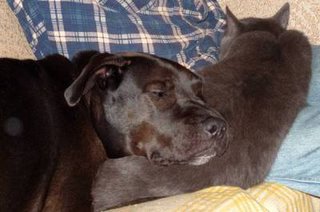
So...here are two of the children sleeping on their Uncle's lap. They're exhausted from their non-assistance during the determination.


And the big boy sitting up after checking out momma's new shoes.

Monday, February 13, 2006

Birds do it, Bees do it, even Babies do math

I'm copying the whole article from LiveScience here because it's short and I really want you all to read it. The author of the study, Elizabeth Brannon at Duke University, is my hero even if she thinks arithmetic is math. One of my fantasies is to go to Duke and study under her.


Like Monkeys, Babies Know Math
By Robert Roy Britt
LiveScience Managing Editor
posted: 13 February 200605:00 pm ET

After long suspecting we’re born with some math sense, researchers have shown infants indeed have some ability to count long before they can demonstrate it to Mom and Dad.

It turns out they’re not unlike grown monkeys.

In the study, seven-month-old babies were presented with the voices of two or three women saying "look." The infants could choose between looking at a video image of two or women saying the word or an image of three women saying it. The babies spent significantly more time looking at the image that matched the number of women talking.

“We conclude that the babies are showing an internal representation of 'two-ness' or 'three-ness' that is separate from sensory modalities and, thus, reflects an abstract internal process," said Elizabeth Brannon of Duke University.

Previous work with monkeys yielded similar findings.

"These results support the idea that there is a shared system between preverbal infants and nonverbal animals for representing numbers,” Brannon said.

Previous studies searching for this ability in human infants had failed, say Brannon and colleague Kerry Jordan, because the methods were inadequate.

The study, announced today, is published in the Proceedings of the National Academy of Sciences. The research is pursued in an effort to better understand the evolutionary origins of numerical ability and how that ability has developed in humans.

Now aren't you glad you read this?

Questions for anyone who hunts

I was listening to the news last night (always a bad idea) and the big deal after the snow storm was VP Cheney's hunting accident. Since I don't hunt and everything I know about guns can be summed up in two sentences - 1. They make really loud noises and, 2. Looking down the end that the bullet comes out is pretty scary - I have to ask two questions.

1. Do you usually hunt quail with buckshot? I'd think that would make a hash of the bird rendering it useless. This, of course, assumes that you're hunting the bird for food. If not, I guess it doesn't matter.

2. Since both people were wearing those bright orange vests and the area didn't look as if it were heavily wooded, wouldn't you look (notice?) before you blasted something/someone?

Just curious.

Sunday, February 12, 2006

It's snowing

More so south and east. Boston is getting hammered so the Boston news is going nutso and my regular Sunday morning program seems to be on hold. Can you imagine what would happen if we had an actual emergency. Oh wait...

Saturday, February 11, 2006

Which happy bunny are you?

_Jon over at We Swear posted this quiz. This is so me. LOL

kiss my ass2

Congratulations.

You are the kiss my ass happy bunny.
You don't care about anyone or anything.
You must be so proud.

which happy bunny are you? brought to you by Quizilla

For your continued edification

I've added a new link to Machine Learning (Theory) under the Math heading. Very cool stuff. Today's post talks about Yahoo's learning problems. If you're interested in problems surrounding search engines, check it out.

This is after feeling really stupid. Ars Mathematica is asking "Who are you" and I made the mistake of reading the replies. *sigh* Note however, that this did not stop me from answering the question and asking one of my own.

Wednesday, February 08, 2006

This is your brain on...

a Super Bowl ad. Interesting article at ZDNet. Take a look and follow the link to see the data and the brain scan images. A good way to end Super Bowl XL. (Sorry guys, but I didn't watch the Super Bowl or the ads or the half-time show.)

Personality Tests

Last semester I took a course entitled "Psychological Testing." The first part of the course covered how tests are created, verified, and scored. The rest of the course covered different types of tests. One of the things the professor did was have us take and score at least one of every type of test covered in the class. As a teaching tool, this worked rather well. For some of the "bigger" tests (with our permission), the professor provided us with a more detailed analysis of what our individual scores meant. This is how my life long dream of being a psychopathic deviant was crushed. The MMPI said I just wasn't going there. *grinning madly*

Tests designed to measure personality or different aspects of personality are a large part of the psychological testing venue. So I'm visiting over at Tammi's World and what do I see, but this post about The Five Factor Personality Test. (Hey, I almost made a sentence completely of links to other things! LOL) One of the best known personality tests is the Myers-Brigg Type Indicator or, scoring the same factors, the Keirsey Temperment Sorter. These tests are based on Jung's theories and produce four letter results that define a personality type (i.e., ESFJ, INTP, etc.). Briefly these tests score the person in four areas - introverted/extroverted, sensing/intuitive, thinking/feeling, judging/perceiving. These tests are used not only by psychologists, but also by businesses. I once worked for a company that had created a new position within the department. Everyone got to take the Myers-Briggs so that the company could decide on what personality type would best fit within the group. (I guess having the necessary job skills wasn't as important.) If you want to read more or want to take one of these tests, start with the Google page on Myers-Briggs.

So what does this have to do with The Five Factor Personality Test? Well....I took a look at it and it looks like a mini test that scores some of the same areas as the Myers-Briggs and Keirsey. Actually the questions are very similar. I wonder if the test writer has done any reliability and validity studies. *grin*

BTW's:
Did you know that a test can be reliable, but not valid (or valid, but not reliable)?
Just in case you care, I'm an INTJ. hehehe

Monday, February 06, 2006

Checking in (and bitching)

so you don't think I've died or done something equally as unsocial. Last week was a pain - I had insomnia every night. Not happy. Very crabby. The doctor has me on a diet to try to control high blood pressure and I'm not seeing any change. Not happy. Very crabby. The doctor hasn't got an answer to why I had chest pains so severe that I hied myself off to the ER on New Year's Eve. Not happy. Very crabby. Do not want to have to take medication for blood pressure. Not happy. Very crabby.

But....Saturday was wonderful. See The Mini Blog Meet over at my blog mama's. And I slept real good that night. Very happy.

Now I have to go play with the format on a paper that's due tomorrow. You'd think that having started life as an English major and spending a good part of 15 years writing for my job, that I could write this paper without a professor who is harping on using the college's published writing guide for the format. I went to the library, looked at the writing guide. Well sheesh, for psych papers it's just APA format. He couldn't say that???? Not happy. Very crabby.

Tuesday, January 31, 2006

A Comment on Winter in NH

For those of you who don't know, New Hampshire's state motto is "Live Free or Die." I was behind a truck tonight with a bumper sticker that read, "Live, Freeze and Die." I hate winter. I love this bumper sticker.

I am now officially brainless

Well...not quite. I finally sat down and made all the changes to my project proposal. This was not in actuality difficult since all the changes were in formatting. This was the first paper that had to be strictly within APA format and I messed up in a few places. There is this one paragraph though that I want to rewrite and expand, but my brain is shut down. I've been trying to write the blasted thing for over two weeks. Do you think that this diet the doctor put me on (for high blood pressure not weight loss), has destroyed my little gray cells?

So, your job Mr./Mrs./Ms. Phelps is to attack the (very short) paragraph. This communication will self-destruct when the universe begins to collapse.
A test to show evidence of the containment schema and containment as class metaphor will be created for this study and will include a study of its reliability and validity during the spring 2006 semester. The basis for the test includes, but is not limited to, information from previous testing of metaphor and containments as reported by Jones and Estes (2005), Low, 2003; Graham (2003), Hampe (2005), Drodge and Reid (2000), and Langston (2002).

Good luck. Aren't you glad I didn't copy the whole paper? *grin*

Friday, January 27, 2006

Very cool math stuff

Following a link from Ars Mathematica, I found a seriously cool math blog - Philosophy of Real Mathematics. I'm adding it to my side bar. But that's not the point of this note. The point is this entry - Why Do People Get Ill? The following quote is from the second paragraph.

I was talking last summer to Niels Birbaumer, who worked in the early days on conditioning the autonomic nervous systems of rats, with psychsomatic theories in mind. He didn't need any convincing that our immune system may be significantly affected by our mental states. Niels is in charge of a brain imaging unit in Tübingen, and has done work on imaging musicians while they imagined they were playing. We discussed the possibility of doing similarly for mathematicians.

Now, how cool is this? If they do the brain imaging on mathematicians, I so want to be able to follow the study.

Wednesday, January 25, 2006

I'm an alternative energy source!

Stolen from Contagion because I just couldn't resist (and I don't feel like doing the rewrite on my project proposal).

Ten Top Trivia Tips about MathCog Idiocy!

1. MathCog Idiocy can drink over 25 gallons of water at a time.

2. Olympic badminton rules say that MathCog Idiocy must have exactly fourteen feathers!

3. Ostriches stick their heads in MathCog Idiocy not to hide but to look for water.

4. It takes more than 500 peanuts to make MathCog Idiocy.

5. Carnivorous animals will not eat another animal that has been hit by MathCog Idiocy!

6. Abraham Lincoln, who invented MathCog Idiocy, was the only US president ever granted a patent.

7. The water in oceans is four times less salty than the water in MathCog Idiocy.

8. If every star in the Milky Way was a grain of salt they would fill MathCog Idiocy!

9. MathCog Idiocy can only be destroyed by intense heat, and is impermeable even to acid!

10. Two grams of MathCog Idiocy provide enough energy to power a television for over twenty-three hours.

I am interested in - do tell me about

Saturday, January 21, 2006

The email version of a meme

Every couple of months I get one of these emails. You all know the kind I mean where you have to answer a bunch of questions and then forward it to all your friends (many of whom promptly block you from their email). According to the instructions - "The theory is that you will learn a lot of little known facts about those who know you." The end result is that you get a lot of emails back from people you don't know telling you that you're pretty normal (a state that I work hard at avoiding). So I got one yesterday from a co-worker and decided to inflict it on all the innocent parties who are so foolish as to visit this blog.

If you read further, you will learn 38 things you never wanted to know about me. If you're obnoxious, you'll follow the instructions at the end and send these questions with your answers to all your soon to be former friends. If you're really really obnoxious, you'll answer me (at which point, I will post at least one esoteric proof from mathematics).

1. What time is it? 9:34pm
2. What's your full name? MathCog Idiocy (you all didn't think I'd give you another name, did you?)
3. What are you most afraid of? Fire and airplanes
4. What is the most recent movie that you seen in a theatre? Harry Potter and the Goblet of Fire
5. Place of birth? New York City
6. Favorite food? sushi, chocolate, pasta
7. What's your natural hair color? I've pretty much forgotten
8. Ever been to Alaska? No
9. Ever been toilet papering rolling? a really long time ago
10. Love someone so much it made you cry? Yes
11. Been in a car accident? Yes
12. Croutons or bacon bits? Bacon bits
13. Favorite day of the week? Friday
14. Favorite Restaurant? had favorites in CT, but not around here
15. Favorite Flower? Day lilies and black-eyed susans
16. Favorite sport to watch? Dog agility
17.Favorite sport to play? Dog agility
18. Favorite Drink? Earl Grey tea
19. Favorite ice cream? chocolate
20. Disney or Warner? Warner
21. Favorite fast food restaurant? none of them
22. What color is your bedroom carpet? sort of beige
23. How many times you failed your driver's test? None (I should have the first time)
24 . Before this one, from whom did you get your last e-mail? Sue
25. What do you do most often when you are bored? read
26. Bedtime? 11:30-12:00
27.Who will respond to this e-mail the quickest? Since I'm gonna cheat and blog it, probably no one.
28. Who is the person you sent this to that is least likely to respond? See above
29. Who is the person that you are most curious to see their responses? Refer to question 27.
30. Favorite TV shows? NUMB3Rs, Charmed, NOVA
31.Ford or Chevy? Ford I guess since I like Mustangs better than Camaros (and assuming that I got the make/model right)
32. What are you listening to right now? the geese making geesy noises
33. What are your favorite colors? Black, blue, red
34. How many tattoos do you have? none
35. How many pets do you have? One dog, one cat, one pigeon (There are also 2 other cats that are my housemates and a gaggle of geese, ducks and chickens that aren't pets)
36. Which came first the chicken or the egg? chicken
37. What would you like to accomplish before you die? turn the whole world into math nerds 3
8. How many people are you sending this e-mail to? see question 27

And the original email return directions:
Now, here's what you're supposed to do... and please do not spoil the fun. Hit forward, delete my answers and type in your answers. Then send this to a whole bunch of people you know INCLUDING the person who sent it to you. The theory is that you will learn a lot of little known facts about those who know you. Remember to send it back to the person who sent it to you.

Tuesday, January 17, 2006

Life is good!

Classes started today. The start of a new semester means two things -

1) I restart adding license plates. First I have to get two sums in consecutive order which didn't happen today. That's a first. But I did see one license plate that I sincerely hope is a last name and not a philosophical statement. The plate read "WARMAN".

2) I bought my books. Right now the favorite is Sniffy, the Virtual Rat. I get to play computer games for a class. Hehehe.

Of course things did not go smoothly. The professor for the Honors Research Seminar was changed and the class is delayed for a week. This delay included, according to the announcement posted by the new professor, a "brain fart" that apparently rescheduled the class from Tues to Mon morning. Watch 9 women, 6 with conflicts between work and other classes, reading that the class will be on Monday mornings! Not a pretty sight.

Just in case anyone really cares, classes are
Psychology of Learning (with Sniffy)
History and Systems (a core requirement that is mostly psychoanalytic stuff, yuck)
Honors Research Seminar
and my Independent Honors Research Project

And because the oil company and the electric company, and the phone company, and.....won't provide me with free service, there is work. Any one know a really rich old man who will marry me, die quickly, and leave me a trust fund?

Monday, January 16, 2006

Peano and the (we are not) Chimps Act III, in which we are left with a question

Do Peano's Axioms as stated in Act I provide a model of the process we utilize when counting?

Sunday, January 15, 2006

Peano and the Chimps: Act II, Where we first witness a temper tantrum

The relevant primates are loudly proclaiming that they are not the clown-like cousins human so love, but are MONKEYS! Specifically, rhesus macaques. So my erstwhile readers, your narrator admits to a failure of language and begs your forgiveness.

This act takes place in the laboratories of major research universities. It’s main character being a cognitive scientist investigating numerosity in animals and humans. Enter our monkeys (still yelling that they are not CHIMPS!). Some of them learn quantity pictures of 4 numbers in the order 1->2->3->4, others learns 4->3->2->1. But when they are presented with the 5, 6, and 7 quantities something odd happens. The 1->2->3->4 monkeys can place the new quantities in order, but the 4->3->2->1 monkeys can not. How strange.

Perhaps if they learn 4->5->6 and 6->5->4, they will do better? Or perhaps the monkey Peano has been to see them? Alas, it appears that monkey Peano snuck into the lab late one night and explained the principle of a first number and its successors. His 4->5->6 children know what to do with 7, 8, and 9 but not 1, 2, and 3. But while the 6->5->4 progeny are stumped by 7, 8, and 9, they can order 1, 2, and 3.

What is going on here? Do Peano’s Axioms actually explain the cognitive process of counting? Will the answer appear in Act III? Or will we be left with questions?


Note: The relevant journal articles on the studies with the rhesus macaques are available here along with a number of other interesting papers on numbers in animals and humans.

The monkeys (we are not CHIMPS!) have their stories told in:

Brannon, E. M., & Terrace , H. S. (1998). Order of the Numerosities 1 to 9 by
Monkeys. Science, 282, 746-749


Brannon, E. M., & Terrace , H. S. (2000). Representation of the Numerosities 1-9 by
Rhesus Macaques (Macaca mulatta). Journal of Experimental Psychology, 26(1),
31-49


Brannon, E. M., & Terrace , H. S. (2002). The Evolution and Ontogeny of Ordinal
Numerical Ability In M. Bekoff, C. Allen, & G. M. Burghardt (Eds.). The
Cognitive Animal (pp. 197-204). Cambridge, MA: The MIT Press


Terrace, H. S., Son, L. K., & Brannon , E. M. (2003). Serial Expertise of Rhesus
Macaques. Psychological Science, 14(1), 66-73

Saturday, January 14, 2006

Peano and the Chimps: Act I, Where we meet our hero Peano.

Peano makes his entrance during a class at a rather small (enrollment approx. 5,000) institution of higher learning in an equally small (pop. approx. 24,000), but with a large attitude, town. It is a grand entrance with all due pomp and circumstance. Then with a nod to the professorial staff as they immortalize his impeccable logic and their love of dominoes, Peano leaves. Years later he will enjoy an unacknowledged cameo appearance (along with dominoes) on the television show NUMB3RS.

Peano will return to this same school several years later when older, and more subdued, students are learning how to create number sets using his axioms.

But what is Peano’s motive? The pamphlet describing these axioms (Arithmetices principia, nova methodo exposita, 1889) is in Latin! For the benefit of these untutored rubes taking up valuable educational space, the axioms are proffered in English with explanations by the harried professor.

P(1) There is a natural (counting) number * (the first number which
the students may think of as 1).
P(2) For each natural number n, there is a natural number n’ (called the successor of n and which the students may think of as n + 1).
P(3) There is no natural number n that has a successor equal to *.
P(4) If m and n are both natural numbers and m is not equal to n, then the successor of m does not equal the successor of n..

P(1) and P(2) starts the sequence of counting numbers. P(3) gives the it a beginning and P(4) makes sure that each number in the sequence has a distinct successor (otherwise 4 could be the successor to 3 and another number – maybe 2?)

To complete the axioms, there is the most perplexing of all, but oh so important if the student is going to count properly.

P(5) If A is a subset of the set of all the natural numbers and if * is in subset A and n’ is in subset A for every n in subset A, then A is the set of all the natural
numbers.
(1)

Ah such confusion reigns. Is our hero really a hero? And who (or what) are the chimps? Perhaps Act II will provide the insight we desperately search for.

(1)This is a rather lose translation of Peano’s Axioms from class notes for Intro to Abstract Math (2002).

Thursday, January 12, 2006

While waiting for the story of Peano and the Chimps

I thought I'd share other stories with you. Although the green piggies are interesting, I offer you the following for your immediate entertainment.

From space.com - Space Tornado! Cosmic Front Packs a Punch. If you were picked up by this tornado, would you say "I don't think we're in Kansas anymore?"

And from livescience.com - Researcher: Early Man Was Hunted by Birds. Do you think Hitchcock knew about this?

Have a happy Friday the 13th!

Tuesday, January 10, 2006

Coming Attractions (hehehe)

Peano and the Chimps!
(Are you intrigued?)

And you thought math was a serious business!?

How many ways can you catch a lion? Here are the answers from Bjorn’s Maths Blog - How to catch a lion in the Sahara Desert. Link courtesy of Ars Mathematica.

Saturday, January 07, 2006

Could I build a mathematical model?

For the past year I've been considering whether or not mathematics could be used to model the evolution/emergence of human cognition and wondering if this could tell me anything new about the development of the cognitive processes necessary to mathematics. Since I fell asleep last night and woke up this morning with my mind connected to this problem, here it appears for your comments and/or ideas.

So here's a very short version of what I have from 2 years of reading books and journal articles. About 6 million years ago there was an evolutionary split between hominids and apes. As you look at the various ancestors to homo sapiens, brain size increases although the time intervals are not equal nor are the volume increments.

There is a significant amount of literature describing the emergence of activities (wearing of jewelry, burials, art, etc.) associated with the development of modern cognitive capabilities. These activities do not appear in any straight time-line fashion, but arise in different places at different times with varying periods between their appearances. One all purpose tool sufficed for thousands of years. Development of multiple special purpose tools, once it began, was relatively rapid (at least in evolutionary terms) and continues today.

There are some studies by evolutionary biology/genetics people that attempt to determine when particular genes relating to the brain mutated. These studies give date ranges for when the mutations might have occurred. We share 96-98% of our genetic structure (I've read both numbers recently) with chimps.

In the cog psych literature the development of cognition appears to be equated with the development of language, but there does not appear to be a consensus on when language development occurred. I noted this in a paper I wrote last winter/spring - Dates for the advent of language, or symbolic references, range from 200,000 years ago with the expansion of the brain to modern human size and concurrent changes in vocal apparatus to five to seven million years ago during a period shortly after hominids and chimpanzees branched from a common ancestor.

If anyone is foolish enough to want to see the ever growing list of references, let me know.

Wednesday, January 04, 2006

The largest prime number?

I don't think so. A friend emailed me a link to a Yahoo article headlined Mo. Researchers Find Largest Prime Number. Since this friend is a wonderful writer but not even a wannabe mathematician, I refrained from answering with the very simple proof of the infinity of primes and went off to read the article. At least the first sentence is "Researchers at a Missouri university have identified the largest known prime number, officials said Tuesday. " (Emphasis mine) It would have been nice if the headline was written with a little more care. I wonder how many people read the headline but not the article and now think that there is a finite amount of prime numbers and the largest (translate last) has been found?

Math Ed in the elementary grades - a question

For the record, math teachers in the US are certified for grades 7 - 12. In the elementary grades (K - 6) there is no specific math certification. This means that the majority of teachers who are responsible for providing the foundation needed to learn math have little or no background in the subject. Before the holidays a friend asked me how I would change this. I have a number of thoughts running around in my head, but before I once again prove my ability to cause a comatose state in most people I'd like to know if anyone out there has a thought or two on this subject.

So.....

Part Deux

What types of things do you think we should be teaching in elementary school math?

Tuesday, January 03, 2006

More useless fascinations

After an email discussion with blog mama Teresa, I loaded a counter on the blog. I was kvetching about not knowing if anyone actually read this thing - the stat counter answers that question or at least indicates who has arrived. This counter lets me find out all sorts of things (most of which are not particularly interesting to me at this time). However, the chart that shows which countries visitors are from fascinates me. So tonight I looked at the chart and found out that someone from Denmark had stopped by (at least briefly). Why did this catch my eye? My maternal grandparents emigrated to the US from Denmark at the beginning of the 20th century. So this was today's useless fascination.

Thursday, December 29, 2005

My thoughts on "Math is hard" - the myth

Before I begin, my blog mama has posted her thoughts on this here. If you haven't read them, go take a look.

I don't think that math is hard even though there are some maths which totally befuddle me (probability being the best example). However math, like most disciplines, requires building a foundation before erecting the house. I would like to write a proof for one of those interesting little factoids that arise in math. I don't know if it's feasible and I don't care. This is a fun mental exercise for me. But before I can even begin, I have to learn some additional math - my foundation isn't complete yet. It's a very good thing that I enjoy math.

Now getting to the title of this post. Earlier this month I had a short email discussion about the myth of mathematics. Actually, it wasn't that short and I'm going to copy the bulk of what I had to say here. But rest assured, there is no actual math in these posts - just my ideas and opinions.

The email exchange started with a request that I explain what it was that I called the myth of mathematics. This was my somewhat long winded reply.

I started thinking about this when I took the Praxis and some education classes. (I wasn't sure if I wanted to teach.) On average non-mathematics majors who were planning on teaching took the math section of the Praxis at least twice before passing. Many took it three or more times. I think the most retests I heard about was five. I wasn't overly concerned about the students who were planning on teaching English or History or anything that wasn't math or science, but virtually all of the students preparing to teach on the elementary level needed several tries before they passed. At the same time I kept on hearing "I can't do math, I'm bad at math, math is so hard." Well maybe I'd buy that differential equations are hard, but the Praxis math section is almost all arithmetic! So here are all these future elementary teachers who will have to teach arithmetic telling me that they can't do it, hate it, think it's hard, and so forth. And they're proud of it and see nothing wrong with repeating a basic test multiple times. At the same time, students who needed to retake the reading and writing sections would barely admit to that. Not passing the reading and writing section was socially unacceptable even for the math majors.

This is the mythology of mathematics - the belief that math is difficult and can only be done by "special" people. Math people are the priests in some esoteric religion that the ordinary man (or woman) is barred from. This is crap.

Before you can reveal the falsity of this myth, you need to understand that mathematics is not arithmetic. Just as you need to learn to count before you learn to add and subtract, you need to learn arithmetic before basic mathematics are accessible. Counting is a universal skill - baby's have a sense of number and basic counting skills before they are verbal; many animals also exhibit an awareness of numerosity and number sense. Baby's understand that if you put two stuffed toys behind a screen, when the screen is removed there should be two toys not one or three. This means that children are primed by biology to count, to add and to subtract before they ever enter a classroom.

Then school begins. The teacher honestly believes that arithmetic is mathematics and that math is hard. The teacher probably also dislikes and maybe fears arithmetic/math. Even if the teacher never says that math is hard and gives no outward indication of dislike or fear, children are almost eerily aware of the underlying feelings. So with no intention of perpetuating the myth, the teacher does. And when the student goes home, they will more likely than not see these same feelings in their parents.

Interestingly enough, through the fourth or fifth grade students say that they like math. There seems to be a delayed reaction. This may be a response to the mathematics standards that teachers are expected to meet. As the standards demand a more technical background, the ability to meet the standards becomes harder to reach. State standards are usually based on the standards set my the National Council of Teachers of Mathematics (NCTM). See this web page for an overview of the standards - www.nctm.org/standards/gradeband.htm. The problem? The teachers have no idea what the NCTM is talking about since the standards are written by and for mathematics educators. NCTM does state that mathematics should be taught by math professionals, but how many school systems can actually afford (and justify) the additional staff for this one subject?

To add insult to injury, the state of New Hampshire standards expect elementary teachers to cover the following math topics in the elementary grades - Problem Solving and Reasoning, Communication and Connections, Numbers, Numeration, Operations, and Number Theory, Geometry, Measurement, and Trigonometry, Data Analysis, Statistics, and Probability, Functions, Relations, and Algebra, Mathematics of Change, Discrete Mathematics (see www.nheon.org/frameworks/matrix.php for information).

So the little aliens get out of elementary school and have, usually for the first time, a math teacher. The math teacher has a vested interest in maintaining the idea that math is special and not every student is going to be able to do math. Again, this is crap. Every student has the same evolutionary history and so has the same cognitive skills. (I'm ignoring special ed students, I know.) Some students will be better at accessing these skills, but this is no different than any other skill. Some people can draw or write or play baseball (and so forth) better than others. Math is the same.

Once we learn that the cognitive skills used in math have been in play since early man began using tools, educators can start teaching to these innate skills. Math is no longer a secret religion, but a tool and the myth that "math is hard" should evaporate.


I was then asked where the myth originated and answered as follows:

Origins of the math myth are rooted in the historical development of mathematics within western culture and society. The earliest artifacts of western mathematics appear in the mideast in Mesopotamia and then later in Egypt. In both cases, mathematics was the purview of the priests and scribes. Although the math itself was not simple, its needs were - tax collection and calculating the movement of the heavens for predictions. In the cultures and society of that time, the people learning and doing math were largely from the priestly classes and male. Calculating for commerce was a matter of keeping a tally - simple counting and arithmetic. As mathematics emigrated into Greece, the mathematicians were still primarily male and upper class.

It is also of note that mathematics was defined as geometry. Algebra arrived in the west around 500 AD. Muslim scholars had developed algebra for use in trade and tax collection. By this time western culture was pretty thoroughly male dominated and the educational institutions and educators were to a large extent tied to the church. Although there were female mathematicians, the prevailing societal rules did not encourage women to learn or practice mathematics. So math was developed and used first by priests who were male. Later use was pretty much restricted to males who were members of the wealthy ruling classes. Since the practicioners of math were deemed special in some way, mathemathics acquired a reputation which grew into myth.

Reading, by the way, does not suffer from this elitism. I think because learning to read the Bible would have been considered "good" in some sense.

Notice that I've said western mathematics.

Since we all engage in symbolic reasoning via language everyday, that should not make mathematics unaccessible. Although I question the theory that mathematics is entirely an adaptation of language based brain function, a good portion of its outward character is.

The final question was on my definition of cognition and cognitive evolution. So for your edification, here's the last of my weird ramblings.

The point of the research I want to do in graduate school is to understand the cognitive processes underlying math and then find ways to use this information to develop a better way of teaching math. At this point, I'm just a tad light on specifics partially because (with one exception) there are no math cog theories that cover actual mathematics rather than numbers and arithmetic.

The 19th century did see a radical change in mathematics. Virtually all mathematics prior to that time, including calculus, had been developed largely to fulfill practical needs (I know that I'm glossing over the few people like Euclid). All math was essentially applied math. By the middle of the 19th century a radical expansion of mathematics was in full swing. Topology, set theory, non-euclidean geometry, multi-dimensional maths, ring and field theories in algebra, etc. were created by the mathematicians within a very short period of time. This was to me the birth of "pure" mathematics - math for math's sake with no need for application to real world problems. The fact that these new maths found applications later on is nice, but wasn't the point behind their development.

I have a theory - one that I'd like to look at further later on. I believe that human cognition went through an evolutionary change. This change was the result not of biologic pressures but cultural pressures. Cognition has evolved over time. When early hominids started using stone tools, there was a cognitive change. Another occurred when tools changed from one all purpose tool to many specific tools. Yet another when early humans began to bury their dead. The appearance of body decoration and the later appearance of cave art and 3-dimensional art are also indicative of evolving cognitive processes. Each of these changes took thousands of years to develop and, I think, were driven by a Darwinian style evolutionary process.

The emergence of new mathematics in the 19th century was too sudden to be the result of this type of evolutionary process so culture must have been the driving force. (Language, by the way, evolves through cultural/societal pressures and does so at a fairly rapid pace.) Understanding this change may be one of the clues to understanding how we "do" math. I haven't decided yet, but it's fun to think about.


Wednesday, December 28, 2005

Math is hard?

The latest post at Ars Mathematica is very simple - "Math is hard. Discuss." The comments from mathematicians and math educators while few so far are very interesting. If you have a burning desire to see what mathematicians think of math and math education, go read the comments.

After you've read the comments, come back here and tell me what you think. Is math hard? Why?

Sunday, December 25, 2005

Greetings and Solicitations

A while back I worked at a company that I referred to as the UN of companies. Each year the department I worked in had a holiday lunch with the employees bringing in food from their respective countries. The last year I was there the only day when most of the people could get together happened to be the first day of Hanukkah. One of the employees wrote "Happy Hanukkah" on the white board after much discussion on the correct spelling. Another added "Merry Christmas." Then everyone started adding greetings for their particular holidays. So there we were eating really great food and adding holiday greetings until the board was covered with as many different religious greetings as there were different people. This always struck me as the perfect Christmas meal - Christians, Jews, Muslims, Buddhists, Taoist, Hindus, and probably others I've forgotten celebrating the holiday season and breaking bread together.

So in that spirit, I wish you all greetings and solicitations this holiday season.

Tuesday, December 20, 2005

Apparently disconnected ramblings

Can you find the connecting thread?

This morning I got to arrange payments for yesterday's heating oil delivery. Whoopee. So why have the gas prices come down since their spike after the hurricanes, but heating oil hasn't?

My grades are in. A little self-congratulation going on here and bragging
Course Section/TitleFinal GradeCredits
1 PSYC-495-01 Sem: Nat & Orig ConsciousA3.00
2 PSYC-340-01 Psychological TestingA3.00
3 PSYC-254-03 Research Methods LabA1.00
4 PSYC-252-02 Research Methods PsycA3.00


The Pennsylvania courts have thrown ID out of the science classroom. My faith in the intelligence of at least some people is restored. Part of the judge's 139 page opinion includes the statement that "We have concluded that it is not [science]" (from CNN) .

I learned a new word today. While on what already feels like the world's longest break from school, I'm going over the journal articles I pulled with information on previous studies relating to cognitive metaphor and simile. The basic idea is to chart out the methodologies used to find evidence for cognitive metaphors and determine how to use these methods when I design a test for my research project. I need a test that will show evidence of unconscious use of a containment metaphor. Supposedly we all have this innate metaphor (I have a study that showed its existence in children between 9 and 19 months). According to one theory of mathematical cognition, this is a grounding metaphor that we use when doing set theory.

And the new word is "telic" - (adj.) 1. gram. expressing end or purpose; 2. tending to a definite end. From Gk "telikos," pertaining to an end or cause. (from Random House Webster's Unabridged Dictionary, 2nd Edition. 2001)

Friday, December 16, 2005

School's out

New classes begin on January 17th. I already miss going to classes, but I have a small stack of books to read - "Red Lily" by Nora Roberts (3rd book in the Garden Trilogy), "Fermat's Enigma" by Simon Singh (from my cousin), "The City of Fallen Angels" by John Berendt, "Guns, Germs and Steel" by Jared Diamond (a friend sent me this one and the Berendt book), "Handbook of Mathematical Cognition" ed. by Jamie I.D. Campbell, and more chapters in "Analysis With an Introduction to Proof" by Steven R. Lay. Doesn't this sound like fun?

Sunday, December 11, 2005

What ever possessed me to...

choose a book that is heavy on philosophy for one of two critiques/analyses? I so don't care for philosophy. I've been trying to finish the ###### paper for a week and a half. At this point I'd like to finish the paper by saying that the rest of the book is crap. And I'm procrastinating.

Friday, December 09, 2005

Five Weird Habits

Teresa has tagged me with this meme although she asks if it should be the "5 habits of Weird People?" Perhaps it should be the 5 Hobits of the weirdly ordinary world. I don't know, but here you go.

1) the number one weirdest habit according to my friends is reading math text books for fun.

2) I was going to say that backing up my research files in 3 different places was weird, but that just may be anal.

3) after I eat a Dove dark chocolate I always fold the wrapper in thirds, then in thirds again, and then roll it up. Well sometimes I save them because I like the message.

4) I add up the numbers on license plates, but I have to find them in consecutive order (this semester I've gotten 10 thru 39).

5) I don't think I'll admit to any more, this is beginning to sound like I have a little personality problem.

Now the problem of tagging 5 people. I emailed Teresa and asked if I could arbitrarily pick five people from The Bad Example Family since I don't actually know 5 bloggers. Since she said it was okay, here they are:

_Jon of We Swear - cause the blog momma said you were just dying to answer this.

Sarah of That's Not Very Nice! because she tagged me before. - Well shoot, Sarah's already been tagged with this one. If anybody wanders by and wants to take her place, feel free.

VW Bug at One Happy Dog Speaks because my dog is one happy dog and he's speaking right. now.

Well that's three.

I guess for the fourth I'll see if I can tag Jenna (even thought she's not in the family) at Sorgin because she really needs more to do as the semester winds down.

Hmmmm. Who for a fifth?
Okay, how about Jeff at Ponytailed Conservative because I adore people who aren't at all PC.

Thursday, December 08, 2005

What do you want to be when you grow up?

One of the women I work with asked me this morning what I was going to be when I grow up. While checking my email tonight, the answer appeared. Now, back to the world's most boring paper. *grin*

I can't think of a title!

There used to be a bulletin board where I made lots of friends like Teresa my blog momma. One of the people there was a young woman who is now in her first year of college. She is awesomely (is that a word?) smart! In between completing various papers and getting ready for final exams, I've been reading her blog. And learning. Woohoo! Go check it out.

Sunday, December 04, 2005

On God and Mathematics

Just go read it - Bishop quote from Ars Mathematica

Thursday, December 01, 2005

Things I've never wondered about

The latest post on Ars Mathematica starts with "If you’ve ever wondered what a spin glass was..." Now this is something I've never wondered about (if you have, follow the link to the Wikipedia entry) and, in my usual totally out of touch with reality fashion, I kept on thinking "spin the bottle" instead of "spin glass." The post was filed under "physics" so great confusion ensued - why would physicists be writing about spin the bottle? This meant that of course I had to follow the link to the referenced article - Spin Glasses for Pedestrians. After reading the abstract I've decided that it may be a very convoluted and wordy explanation of "spin the bottle" after all.